
Loading...
A slope that washes out every spring, water that runs toward your foundation, or a yard you cannot use - a properly built retaining wall solves all three and holds up through decades of central Illinois winters.
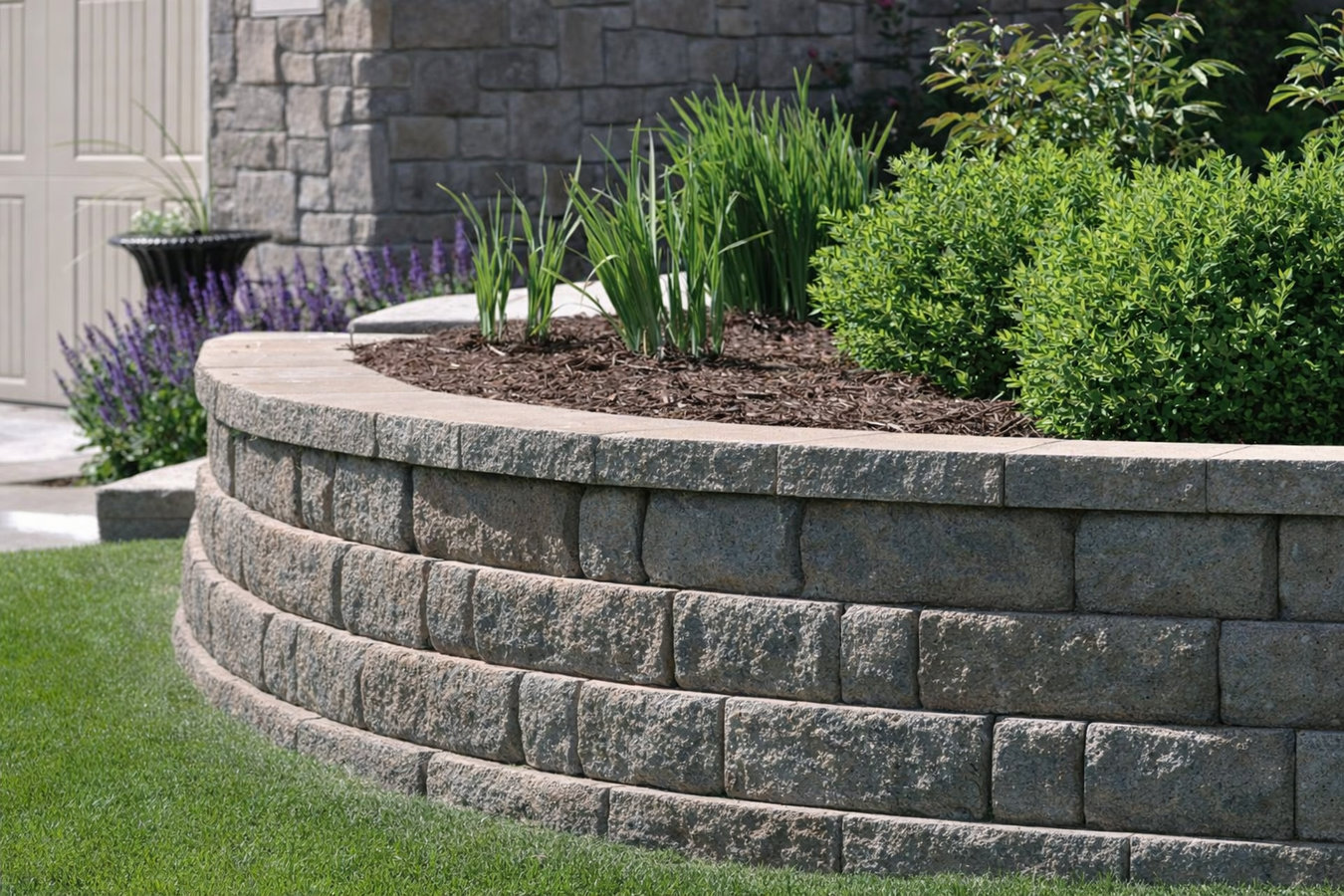
Retaining wall construction in Champaign, IL means building a structure that holds back soil on a slope so it does not erode, shift, or direct water toward your home - most residential projects run two to four days on-site once permits and utility locating are complete.
In Champaign, the conditions that make a retaining wall necessary are also the conditions that make it tricky to build well. The clay-heavy soil holds water instead of letting it drain away. Champaign winters push the ground up and down repeatedly as temperatures cross the freezing point. A wall built without proper drainage behind it or a base set above the frost line will lean or crack - not because the material failed, but because the installation did not account for local conditions.
If you are also thinking about the hardscape alongside the wall, our masonry restoration service can handle repairs to existing stone or brick structures on the same property, so you are not left with a new wall next to an aging one.
Bare patches, small channels carved into the ground, or soil piling up at the base of a slope after a storm are signs of active erosion. In Champaign, heavy spring rains and clay-heavy soil can accelerate this quickly. A retaining wall stops the movement and gives you a stable, usable yard.
When a slope directs runoff toward your house instead of away from it, puddles form near the foundation after rain. Over time that water works into basements and crawl spaces. A retaining wall combined with proper grading redirects water before it becomes an interior problem.
A wall that tilts forward, shows horizontal cracks, or pulls away from the soil is telling you drainage behind it has failed or the base has shifted. In Champaign's freeze-thaw climate, walls built without sufficient base depth show these signs after just a few winters. A leaning wall will not correct itself.
A gentle but persistent slope can make it impossible to set up a patio, a garden, or even a flat lawn. A retaining wall lets you cut into that grade and create a level terrace. This is one of the most common reasons homeowners in Champaign's established neighborhoods call for a wall.
The most common residential choice in Champaign is interlocking concrete block - it handles clay soil and freeze-thaw cycles well, drains properly when installed with the right backfill, and holds up longer than timber in a wet Illinois spring. For properties where appearance matters as much as function, we also build natural stone walls that fit the character of an established yard. If you are dealing with a taller wall or a situation requiring the maximum in structural strength, poured concrete is the right conversation to have. Alongside new construction, we rebuild walls that have failed due to drainage problems or inadequate base depth - which is more common in Champaign than most homeowners realize. When a larger masonry scope is involved, our concrete block walls service handles structural and property-boundary wall projects.
The National Concrete Masonry Association (NCMA) sets the design and installation standards for segmental retaining walls, and we follow those guidelines on every block wall project. For projects that require utility locating before digging, Illinois law requires contractors to call 811 through JULIE - the Illinois One-Call System - we do this on every project without exception.
The most practical choice for most Champaign yards - interlocking block handles freeze-thaw cycles well and drains properly when installed with the right backfill.
For homeowners who want a wall that fits in with an established landscape or historic property - beautiful, long-lasting, and built to shed water naturally.
Best suited for taller walls or commercial-adjacent applications where maximum strength and a clean, uniform face are the priority.
For existing walls that have leaned, cracked, or had drainage fail - often more cost-effective to rebuild correctly than to keep patching a wall that has lost its footing.
Champaign receives about 40 inches of rain per year, with the heaviest falls in spring, and the region sits on flat prairie land with clay soil that does not drain quickly. In yards with any slope at all, that combination sends water pooling against structures and foundations. Homeowners in Champaign discover they need a retaining wall most often after noticing erosion channels or water collecting near their house after a spring storm. The freeze-thaw cycle compounds the problem: water that saturates the soil in fall freezes in place in winter and expands, pushing against whatever is nearby. A wall designed and built for those specific conditions - with drainage gravel behind it and a base below the frost line - is what holds. One that was not built with those details is what leans.
We work across the Champaign area, including Mahomet and Savoy, where the same clay soil and drainage conditions are present. Whether your yard is a compact older lot on the north side or a larger property on the west side, the approach is the same: assess the slope and drainage situation first, then build what the conditions actually require.
We come out, look at the slope and drainage situation, and give you a written estimate. A good contractor looks at more than just the wall length - soil conditions, drainage, and how the yard is graded all affect the design. We respond within 1 business day of your inquiry.
If your wall requires a City of Champaign permit, we handle the application before any work begins. Illinois law also requires contractors to call 811 to have underground utilities marked before digging - we do this on every project without exception.
We dig below the frost line - about 42 inches in central Illinois - and build a compacted gravel base that keeps the wall from shifting during Champaign winters. This is the most time-intensive part of the project and the part that determines long-term stability.
As each course goes up, we pack drainage gravel behind the wall and install perforated pipe where needed. This step is invisible once the work is done, but it is what separates a wall that lasts 30 years from one that leans after five. We walk you through the finished work before we leave.
We come out, look at the slope and drainage situation, and give you a written estimate with no obligation.
(217) 316-8581We have been building retaining walls in Champaign and the surrounding communities since 2020. We know the clay soil, the freeze-thaw pattern, and the city permit process. The National Concrete Masonry Association sets the installation standards we follow on every concrete block wall project.
We have been building retaining walls in Champaign and the surrounding communities since 2020. We know the clay soil, the freeze-thaw pattern, and the city permit process. The National Concrete Masonry Association sets the installation standards we follow on every concrete block wall project.
We have been building retaining walls in Champaign and the surrounding communities since 2020. We know the clay soil, the freeze-thaw pattern, and the city permit process. The National Concrete Masonry Association sets the installation standards we follow on every concrete block wall project.
We have been building retaining walls in Champaign and the surrounding communities since 2020. We know the clay soil, the freeze-thaw pattern, and the city permit process. The National Concrete Masonry Association sets the installation standards we follow on every concrete block wall project.
A well-built retaining wall is one of the most durable improvements you can make to a Champaign property. Getting the base depth and drainage right from the start is the difference between a wall that lasts 50 years and one that needs rebuilding in five.
If an existing stone or brick wall on your property needs repair rather than full replacement, masonry restoration work brings it back without starting over.
Learn MoreFor structural or property-boundary walls built from concrete masonry units - a durable option well-suited to Champaign's soil and climate conditions.
Learn MoreSpring is the busiest season for retaining wall work in Champaign - call or send your info now to get on the schedule before the rush.